
A Moment I’ll Never Forget
There are moments in life you can’t forget—even if you tried. One of those moments for me was the day I was baptized in the name of Jesus Christ.
I was sitting in the baptismal tank at the Pentecostal Worship Center in Spring City, Tennessee. Pastor Mike Grace stood beside me, and my uncle Jerry Hayes was right there as a witness. I’ll never forget the feeling. When Pastor Grace took me down into the water, calling on the name of Jesus, and I came up—something broke. A tremendous weight lifted off me. It wasn’t just water on my skin; it was something happening in my soul. That day marked me forever.
Since then, I’ve had the incredible privilege of baptizing friends, family, and brand-new believers in that same precious name. And every single time, I feel that same joy—because I know what Jesus’ name does.
What Does Baptism Symbolize?
Have you ever thought about what baptism really means? Why do we go under the water? What’s happening in that moment?
While baptism is more than a symbol, it carries deep spiritual significance. The apostle Paul explains it powerfully in Romans 6:3–4 (NKJV):
“Or do you not know that as many of us as were baptized into Christ Jesus were baptized into His death? Therefore we were buried with Him through baptism into death, that just as Christ was raised from the dead by the glory of the Father, even so we also should walk in newness of life.”
Baptism is a burial. Just like Jesus died, was buried, and rose again—when we’re baptized, we’re identifying with His death, burial, and resurrection. We’re burying the old life and rising to walk in a brand-new one.
Paul reinforces this in Colossians 2:12 (NKJV):
“Buried with Him in baptism, in which you also were raised with Him through faith in the working of God, who raised Him from the dead.”
Baptism is also a symbol of cleansing—washing away sin (Acts 22:16), a public expression of faith, and the moment we “put on Christ” (Galatians 3:27). It’s the outward act that signifies an inward change. But most importantly, it’s where the name is applied.
So yes—baptism is symbolic, but it’s not only symbolic. It’s a spiritual transaction. Sins are remitted. The old man is buried. A new life begins. And all of it happens in the name of Jesus.

The Apostolic Pattern: One Name
Why did the apostles baptize in Jesus’ name? Were they being disobedient—or were they actually obeying Jesus to the letter?
As a UPCI preacher, I stand on the foundation laid by the apostles. We baptize in the name of Jesus—not because it’s a tradition, but because it’s truth.
In Matthew 28:19 (NKJV), Jesus gave His disciples a clear commission:
“Go therefore and make disciples of all the nations, baptizing them in the name of the Father and of the Son and of the Holy Spirit.”
Notice—Jesus said to baptize in the name (singular), not “names.” That’s not just a grammatical detail; it’s a theological key. So what is the name?
The apostles knew exactly what Jesus meant. They didn’t repeat His words—they obeyed them. They knew that Jesus was the name that represented the fullness of the Godhead. That’s why every baptism in the New Testament was done in Jesus’ name:
- “Repent, and let every one of you be baptized in the name of Jesus Christ for the remission of sins…” — Acts 2:38 (NKJV)
- “They had only been baptized in the name of the Lord Jesus.” — Acts 8:16 (NKJV)
- “And he commanded them to be baptized in the name of the Lord.” — Acts 10:48 (NKJV)
- “When they heard this, they were baptized in the name of the Lord Jesus.” — Acts 19:5 (NKJV)
The apostles weren’t confused or contradicting Jesus—they were fulfilling what He commanded. The name of the Father, Son, and Holy Spirit is Jesus.
Dr. David K. Bernard said on his podcast Why We Baptize in Jesus’ Name.
“I think Christians of all backgrounds and denominations would agree, at minimum, that baptism is a way of confessing Jesus as our personal Savior and committing ourselves to Him. So it makes perfect sense that if baptism is about confessing Jesus as Savior—if it’s part of our entrance into the body of Christ and the New Testament church—then the name that should be used in baptism is obviously the name of Jesus.”
When Did the Formula Change—and Why?

If the early church baptized in Jesus’ name, why do most churches today use the phrase “in the name of the Father, and of the Son, and of the Holy Spirit”?
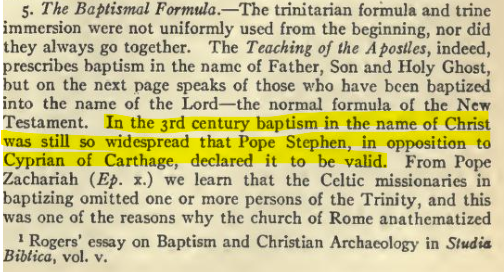
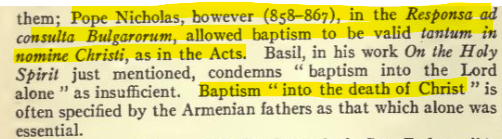
Historical records show that the original practice of Jesus’ name baptism began to shift in the second and third centuries. Figures such as Tertullian began emphasizing the titles in Matthew 28:19 rather than the name. Tertullian, writing around AD 200, referenced the Trinitarian formula:
“…the law of baptism has been imposed and the formula prescribed: ‘Go,’ he says, ‘teach the nations, baptizing them into the name of the Father and of the Son and of the Holy Spirit.’” (On Baptism, Ch. XIII)
This marked a theological shift. Over time, church councils and creeds solidified the Trinitarian formula as the standard.
But even reputable historical sources acknowledge the change:
- Encyclopedia Britannica (11th ed., Vol. 3, pp. 365–366): “The baptismal formula was changed from the name of Jesus Christ to the words Father, Son, and Holy Ghost by the Catholic Church in the second century.”
- The Catholic Encyclopedia (1913, Vol. 2, p. 263): “The baptismal formula was changed from the name of Jesus Christ to the words Father, Son, and Holy Ghost by the Catholic Church in the second century.”
- Hastings Dictionary of the Bible (1898, p. 88): “It must be acknowledged that the threefold name has no early support as the baptismal formula, and that the baptism was in fact done in the name of the Lord Jesus.”
Some argue that Matthew 28:19 must be quoted word-for-word. But the apostles, who personally heard Jesus speak these words, did not repeat them verbatim. Instead, they obeyed His command by baptizing in the name that holds all authority—Jesus.
“And whatever you do in word or deed, do all in the name of the Lord Jesus…” — Colossians 3:17 (NKJV)
Modern Catholic Arguments
Even modern Catholic arguments unintentionally reinforce the biblical stance. In an article from Catholic.com, several points are made:
- They admit the apostles baptized in Jesus’ name, but argue it was a shorthand for the Trinitarian command. But if Jesus’ name was enough then—why not now?
- They emphasize tradition and church authority over Scripture alone, acknowledging the formula changed under ecclesiastical guidance. This supports—not weakens—the claim that the change wasn’t rooted in Scripture.
- They acknowledge the lack of explicit repetition of Matthew 28:19 in practice throughout the book of Acts. This silence speaks volumes.
So we ask: Are we going to follow church history, or the apostles who walked with Jesus?
Is Baptism Necessary for Salvation?
What about the thief on the cross? Isn’t that proof baptism isn’t necessary?
Some Christian traditions teach that baptism is symbolic or optional—“an outward sign of an inward faith.” They often point to the thief on the cross as proof that baptism isn’t required for salvation.
But let’s dig deeper.
The thief on the cross died before the resurrection. He died under the Old Covenant, while the law was still in effect. Jesus had not yet shed His blood, risen from the grave, or poured out His Spirit. The New Covenant, as established by Jesus, began after the resurrection.
That’s why the apostolic message after the resurrection was clear:
“He who believes and is baptized will be saved…” — Mark 16:16 (NKJV)
“Repent, and let every one of you be baptized in the name of Jesus Christ for the remission of sins…” — Acts 2:38 (NKJV)
“There is also an antitype which now saves us—baptism…” — 1 Peter 3:21 (NKJV)
Scripture is consistent: Baptism is not optional—it’s essential. It’s where our sins are remitted and where we are buried with Christ (Romans 6:4), and where we put on Christ (Galatians 3:27).
Have you ever asked yourself, “Have I been baptized the way the apostles taught?”
A Life Changed by the Name: My Story and Ernestine’s
I wasn’t raised Pentecostal. I didn’t grow up around this kind of teaching. But when I walked into a Spirit-filled, Jesus-name preaching church, I felt the difference. I felt the power and presence of God in a way I never had before. And when I was baptized in Jesus’ name, I was changed. Not just emotionally—but spiritually. Washed. Forgiven. Born again.
Not long ago, I met Ernestine—a woman with an incredible story of her own.
She had been struggling with severe sleep issues that were taking a real toll on her. One night, a few brothers from the church and I gathered to pray with her. We anointed her with oil and laid hands on her, asking God to bring peace and healing.
Right then and there—God moved. She was filled with the Holy Ghost and began speaking in tongues for the very first time! And from that night on, she began sleeping peacefully.
She later told me she wanted to be baptized in the name of the Lord Jesus. So we made it happen—right there in a portable baptismal tank, set up in the elementary school where we were holding church services.
When she came out of the water, she looked at me and said she felt “lighter” and “amazing.”
Two people. Two stories. One powerful name.
That’s the power of Jesus’ name. That’s what happens when someone gives their all to Him.

Final Thoughts: What Will You Do With the Name?
Let me ask you something: Have you experienced the name of Jesus in baptism? Have you gone down in that water and come up new? Are you still carrying around the weight of your past?
You don’t have to.
Jesus is calling. The water is ready. The name is above every name. And your new life is waiting on the other side of your obedience.
When you’re ready, Jesus is ready to meet you there.
Find a church that will baptize you in His name by clicking here and scrolling down to “church locator.”
What to learn more? Watch this 26 minute sermon on baptized in Jesus name.
 Apostolic Insights
Leave a comment